Quill Cowork has confidential mode and trusts you with the bill
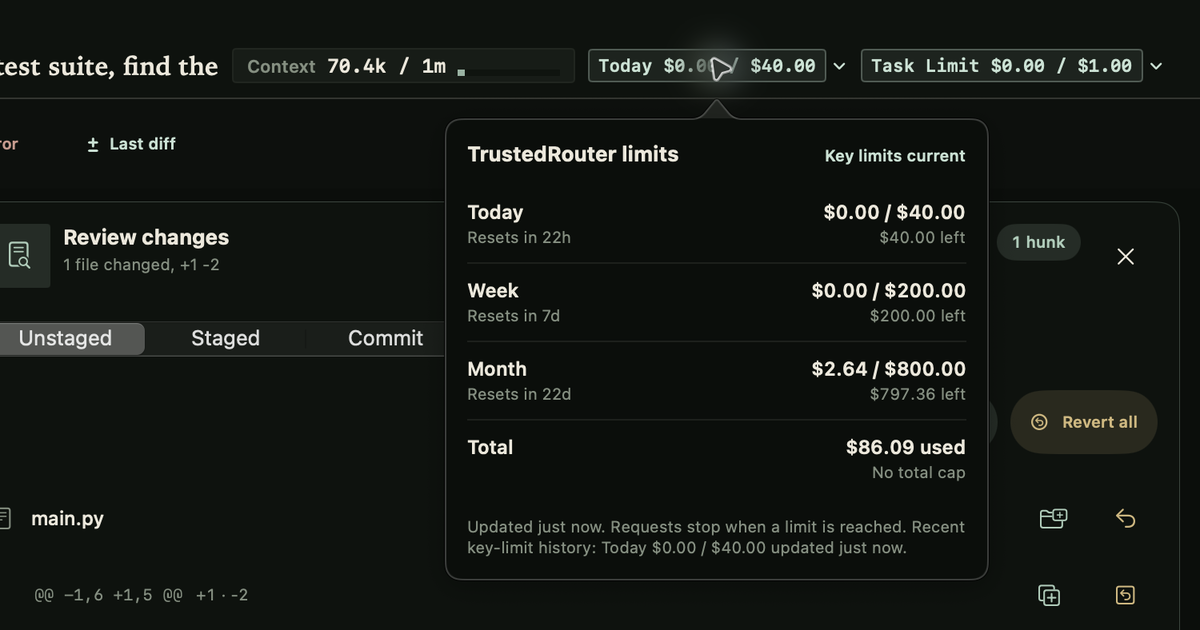
If you hire someone and they will not tell you what they spent, you fire them. Agents get a pass on this for no reason I can defend, so QuillCode has a meter in the top bar: tokens used against the limit, what is left, and where the number came from. It updates while the agent works. You can watch a bad prompt get expensive in real time, which is the only feedback loop that ever made me write better prompts.
The interesting bug showed up when I added the private mode. QuillCode has /confidential, which opens a chat that is never written to disk, never appears in the sidebar, carries no workspace memories, and is pinned to an end-to-end encrypted route. When you leave, the thread is destroyed. Clean.
Except the spend went with it. Destroying the thread destroyed its receipt, so the money spent inside a confidential chat quietly vanished from the period ledger. You could run up a bill in private mode and the books would never know. Nobody designed that; it fell out of "destroy everything about this thread" meeting "the ledger lives on the thread." A private chat should forget your words and keep your receipt. Now it does.
That bug was one of about a dozen. Five rounds of adversarial review on the confidential mode found side doors in places I would not have guessed: subagent stores, attached image bytes, the memory tool, automations, run hooks, computer-use artifacts, OS notification bodies, a settings save that overwrote the pinned model, context refills, fork and compact and duplicate, and an auto-safety-reviewer that shipped the transcript to a different model to summarize it. Every one of those is a path where "not saved" or "always encrypted" quietly stopped being true. The lesson generalizes: every typed slash command bypasses whatever you gated in the menu, so the guard has to live on the model, not the UI.
The mode pins to an end-to-end route because a promise about deletion is worth very little if the words were readable on the way out. I have written about what confidential computing actually gets you and why attestation is the part that makes it checkable. You can also constrain a confidential chat to US-only or EU-only models, which sounds like compliance theater until you remember that where a model is hosted changes what it will say and that some of them go silent on entire topics.
The counterargument is that this is over-engineering for a solo tool. It would be, if the failure were visible. A leaked prompt does not throw an exception and an unbilled thread does not page you; both look exactly like everything working. That is precisely the class of thing you have to go looking for on purpose, which is why it took five rounds and why I keep testing the claims instead of reading the policy page.
Watch the meter, and know when you are off the record.