Open Source all native Swift harness (NO Electron!)
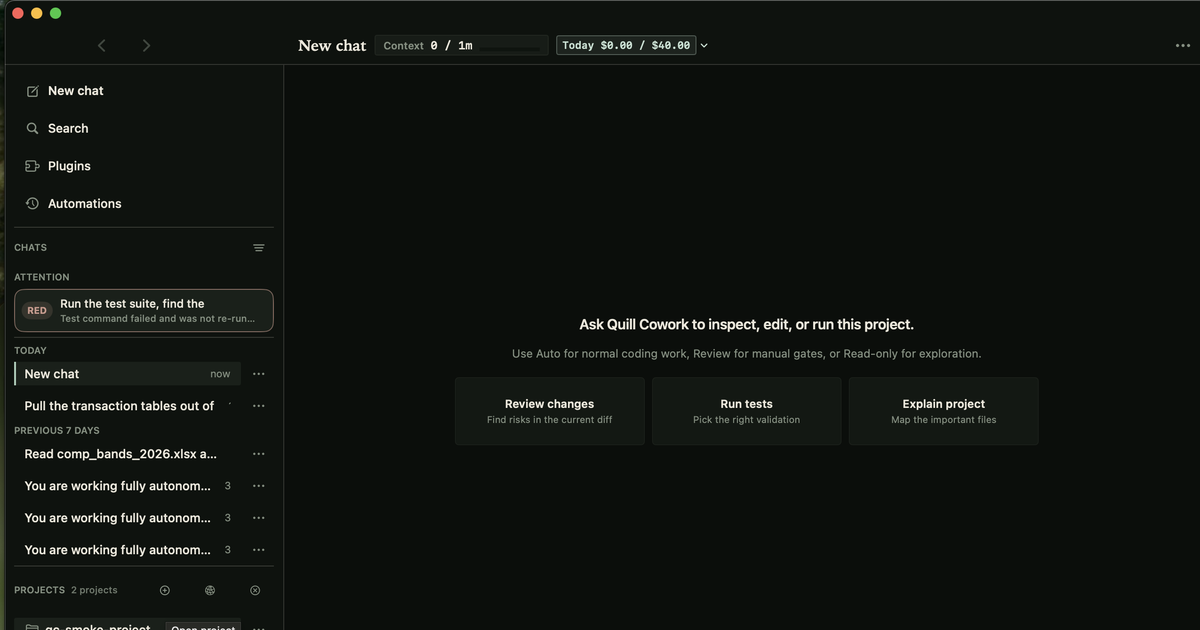
The coding agent I use every day is open source now. It is called QuillCode, it is a native Mac app written in Swift, and it runs on my laptop instead of in somebody else's datacenter.
That last part is the whole point. Almost every useful thing I want an agent to do involves my machine. Run the test suite. Open a worktree and try the risky refactor there. Drive a browser and check that the page actually renders. Read the log file that never leaves my disk. An agent living in a web app can do none of that, so it does the one thing it can do — write code into a text box — and hands the hard half back to you. The hard half is the part I wanted help with.
It is also not an Electron app, which I say with some feeling. The current default for shipping a desktop tool is to bundle an entire browser engine so the team can write the interface in the language they already know, and the result is a text box that eats four hundred megabytes of disk and a couple hundred of RAM before it has done anything. Every one of these apps feels the same: a beachball on a window resize, a scroll that is almost but not quite native, a menu bar that is a drawing of a menu bar. QuillCode's interface is Swift and AppKit. It launches immediately, it scrolls the way every other Mac window scrolls, and the file picker is the file picker. That is not nostalgia, it is the difference between a tool you keep open all day and one you quit because it is heavy.
So QuillCode has local tools, real worktrees, computer use, automations, and a plugin system, and it updates itself with verified builds. It is about sixty thousand lines of Swift with sixteen hundred tests behind it and something north of six hundred and eighty merged pull requests. I mention the test count because a coding agent that edits your repo is exactly the kind of software where you want to know somebody was paranoid.
It is backed by TrustedRouter, which means you choose the model instead of inheriting one. That matters more for coding than for chat, because coding is where the gap between models shows up as wasted hours. Sometimes you want the cheap fast one for a rename and the expensive one for the design; I wrote about how to choose and about the fact that the best open models are not on your leaderboard. QuillCode ships with Socrates 1.1 in the recommended list because it scored 72 on Terminal-Bench Hard, and a coding harness should default to something that can actually finish a terminal task.
The obvious objection is that a local agent is a worse agent — no fleet of GPUs behind it, no magic. That gets it backwards. The model still runs remotely; what runs locally is the part that touches your files, and that part should be a program you can read. The frontier is available to me either way. I get frontier-quality output at open-source prices through the router, and I get to keep the file system access on my side of the wire.
The other objection is privacy, and it is the serious one, because a coding agent reads everything. That is why the prompt path is verifiable rather than promised and why the gateway attests what code is receiving your prompts. If you are going to point an agent at a private repo you should be able to check where the words went.
Everything else I build is open too — the router, the evals, the proxy. Take the repo, read the parts you do not trust, and run it against your own key.